
Easy there, Romeo
One thing is certain—there’s never a dull day at ʻĀina Iki Ranch.
I was making my way to the front of the property one morning to tend to our two smallest flocks of ducks. A bucket of feed in hand and a smile on my face as I greeted Goliath and his gals, and good ol’ Dickie Duck…
And that smile quickly turned into a dumbfounded, wildly loud Marla laugh when I looked past the ducks and into our Biggie goat pasture to see Romeo - in all his glory.
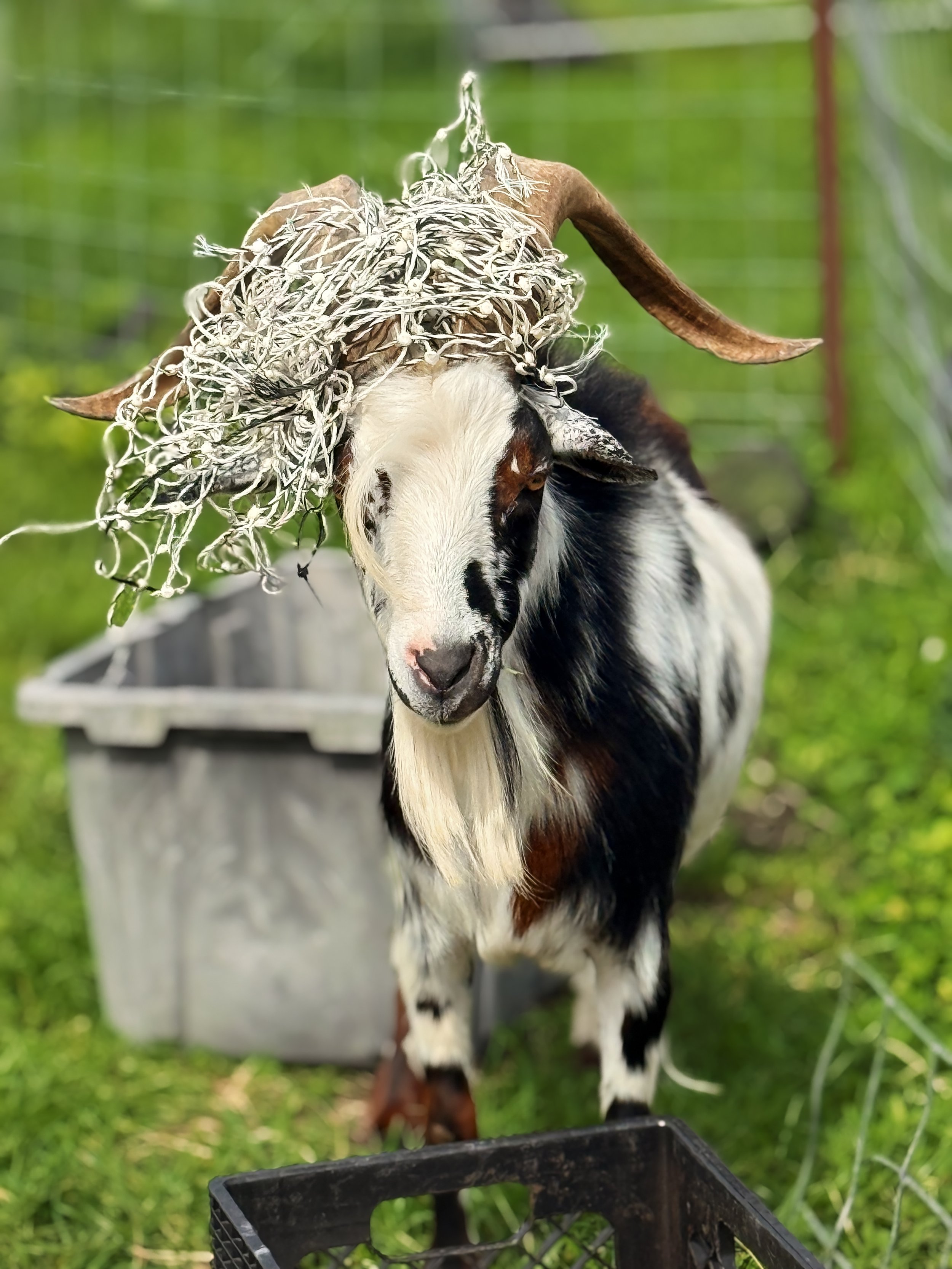
Romeo and his Crown of Shame
Apparently, the evening before, Mr. Romeo decided he wanted to explore beyond the pasture… by going straight through one of our electric fences.
Thankfully, the fence wasn’t live.
Unfortunately, that didn’t stop him from getting completely tangled—leaving Val with quite the job of cutting him free.
She managed to get most of it off him, but felt it only fitting to let him wear his “crown of shame” for at least half a day—as a reminder to himself (and perhaps the rest of the Biggie herd) that curiosity has its consequences.
Once my laughter subsided, I heard Val call out from the porch:
“I see you’ve caught sight of Romeo’s crown!”
After a shared chuckle, Val—of course—turned the whole thing into a learning moment.
We pulled Romeo away from the herd, got him up on the stanchion, and took his measurements to estimate his weight:
Weight (lbs) = (Heart Girth² × Body Length) ÷ 300
Once we had his weight, Val walked me through how to properly calculate medication dosages to keep him strong and healthy. Any time we’ve got a goat on the stanchion, it just makes sense to do a quick check-up.
After getting his fenbendazole and copper dosed and administered, we decided it was finally time to dethrone Romeo. I kept him busy with treats while Val did the hard work of cutting away the fencing from his horns.
Now here’s where things get a little “goat nerdy.”
Most folks (myself included, at first) would assume that goats with horns are the dominant trait. But as the old adage goes… assuming makes an *** out of you and me.
In reality:
The polled (hornless) gene is dominant
The horned gene is recessive
Which means:
Polled goats can carry hidden horn genetics
And horned goats only show up when both recessive genes are present
To take it one step further—you generally don’t want to breed two polled goats together. In goats, the polled gene is linked to sex development, and doubling it up can sometimes result in intersex kids.
Thankfully, Romeo—as his name would suggest—is a strong, healthy boy with none of those complications.
He was castrated a bit later in life, after an initial attempt with a Burdizzo didn’t quite take. And let’s just say… that timing played a role in how he earned his name.
Because of that late castration, Romeo got a full introduction to the “romantic” side of life. These days, anytime we have a doe in heat, Romeo is right there by her side—ready to claim her as his one true love (at least for the few days her heat lasts).
And honestly? It’s a blessing in disguise. His behavior gives us a clear signal of what’s happening in the herd—something that’s incredibly helpful out here.
All in all, I never would have learned so many oddly fascinating goat factoids without Romeo… and his unforgettable Crown of Shame.
Mahalo for keeping life interesting, Romeo. 🙏🏻🐐👑
If you’d like to support Romeo and follow along with even more of his antics, he is available for virtual adoption here at ʻĀina Iki Ranch.
Adopters receive access to our Donor Den—a space where we share deeper behind-the-scenes stories, care practices, and the day-to-day life of the animals you help support. Romeo, as you might imagine, gives us no shortage of stories to tell.
